How Long Can an AHD Vehicle Camera Cable Be? Real-World Signal Distance Explained
For many truck CCTV projects, the camera cable looks like a small detail. In reality, it can decide whether the whole system works smoothly or becomes unstable after installation. AHD vehicle cameras are widely used on trucks, trailers, buses, tankers, construction vehicles, and fleet monitoring systems because they can provide HD video through analog-style coaxial cable. But one common question from buyers and installers is: how long can an AHD vehicle camera cable really be?
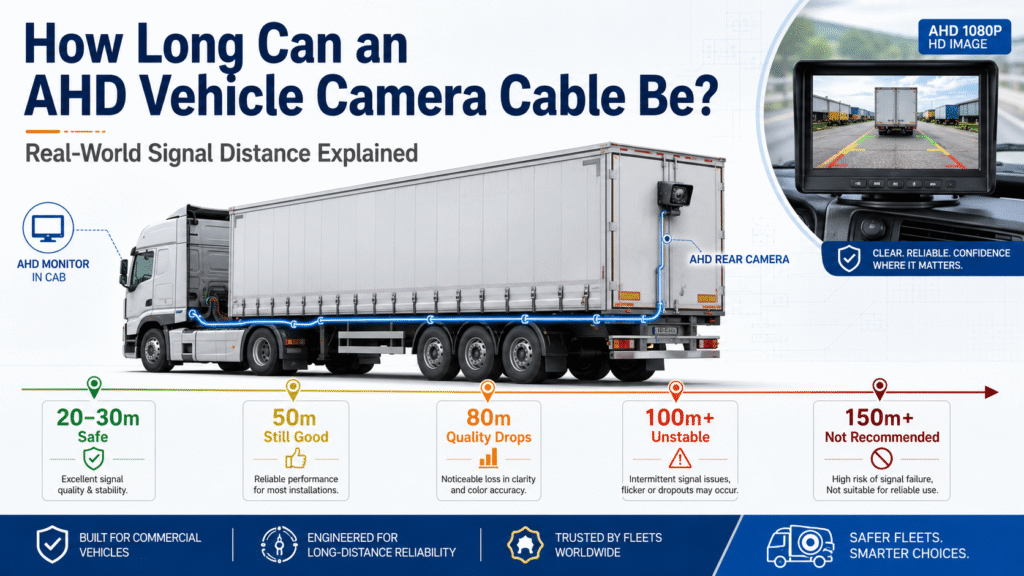
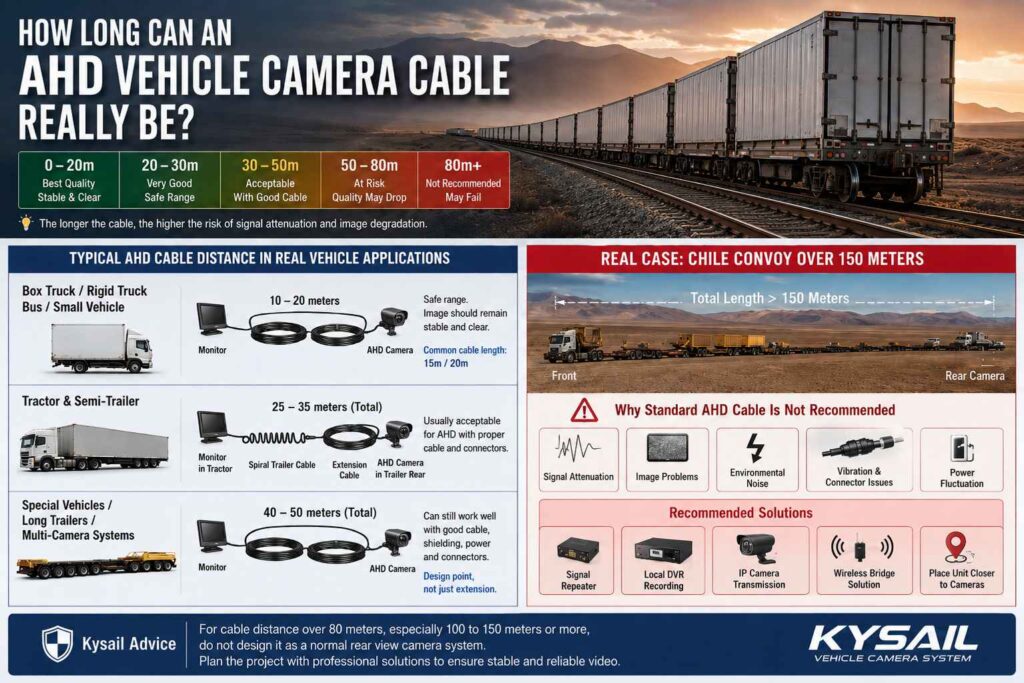
The simple answer is: for normal truck and trailer applications, AHD camera cable length is usually safe within 20 to 30 meters. With good cable quality and correct installation, 50 meters can still work well. After 80 meters, the video quality may start to drop. Around 100 meters or more, the image may become black and white, unstable, rolling, or completely lost. For very long convoys over 150 meters, a standard AHD cable design is usually not recommended without special signal planning.
Why AHD Cable Length Matters in Vehicle CCTV Projects
AHD means Analog High Definition. It can transmit 720P or 1080P video through coaxial cable, which makes it very useful for commercial vehicles. Compared with traditional CVBS cameras, AHD gives a much clearer image, especially on 7 inch, 10 inch, or larger fleet monitors. Drivers can see reversing areas more clearly, fleet managers can review recorded video with better detail, and installers can offer a more professional solution.
However, AHD is still a video signal that travels through cable. The longer the cable, the more signal loss, noise, and interference may appear. This is especially important on tractor and trailer systems, where the camera may be installed at the rear of the trailer, while the monitor or DVR is installed inside the cab. If the cable is too long, or if the connector and cable shielding are poor, the camera may not be defective but the signal may simply be too weak when it reaches the monitor or DVR.
Typical AHD Cable Distance in Real Vehicle Applications
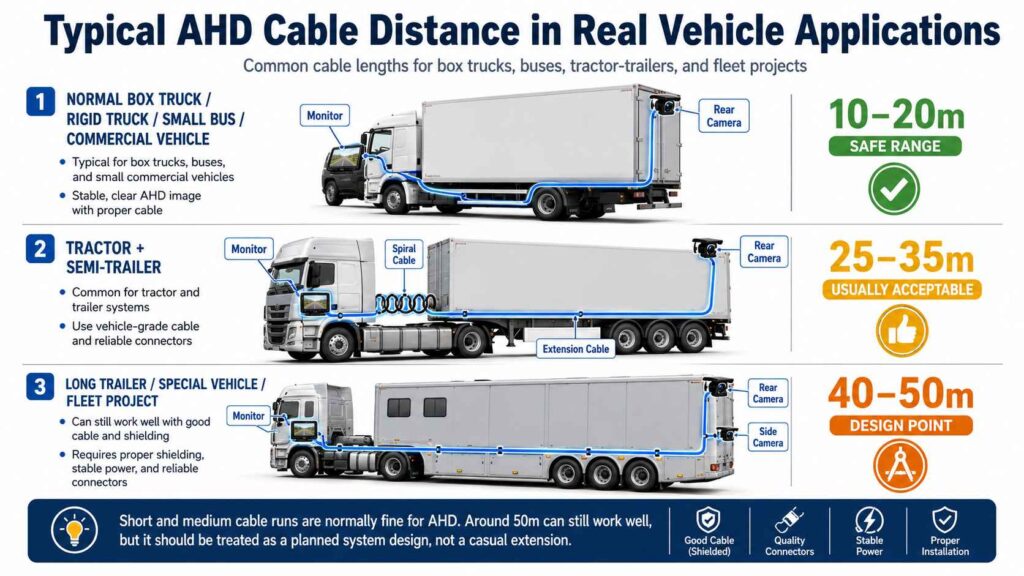
For a normal box truck, rigid truck, bus, or small commercial vehicle, the rear camera cable is often between 10 and 20 meters. This is a safe range for AHD. If the cable is correctly made, the image should remain stable and clear. This is why many standard rear view camera kits use 15 meter or 20 meter extension cables.
For tractor and semi-trailer applications, cable length can become longer. A common design may include a monitor cable in the tractor, a spiral trailer cable between tractor and trailer, and a long extension cable from the trailer front to the rear camera. The total signal path may reach 25 to 35 meters. This is still usually acceptable for AHD if proper vehicle-grade cable and connectors are used.
For special vehicles, long trailers, multi-camera systems, or customized fleet projects, the total distance may reach 40 to 50 meters. In Kysail’s experience, AHD at around 50 meters can still work well when using good cable, proper shielding, stable power supply, and reliable connectors. But this should already be treated as a design point, not just a casual extension.
What Happens When the Cable Is Too Long?
When AHD cable length goes beyond the practical limit, the first problem may not be a complete black screen. Many installers first see small problems such as reduced sharpness, noise, flickering, or unstable color. Sometimes the image can still appear on the monitor, but the quality is not good enough for safe reversing or reliable recording.
At longer distances, the image may turn black and white. This is a common sign that the video signal is weak or distorted. Some monitors may show a rolling image, wrong color, or intermittent video. In more serious cases, the monitor may show no signal at all. The installer may then suspect the camera, monitor, or DVR is broken, but the real reason may be excessive cable length or poor signal transmission.
Power voltage drop is another common problem. Many vehicle camera cables carry both video and power. If the power wire is too long or too thin, the voltage arriving at the camera may be lower than expected. The camera may work during daytime but become unstable when IR LEDs turn on at night, because night vision requires more current. This is why long cable projects must consider both video signal loss and power voltage drop.
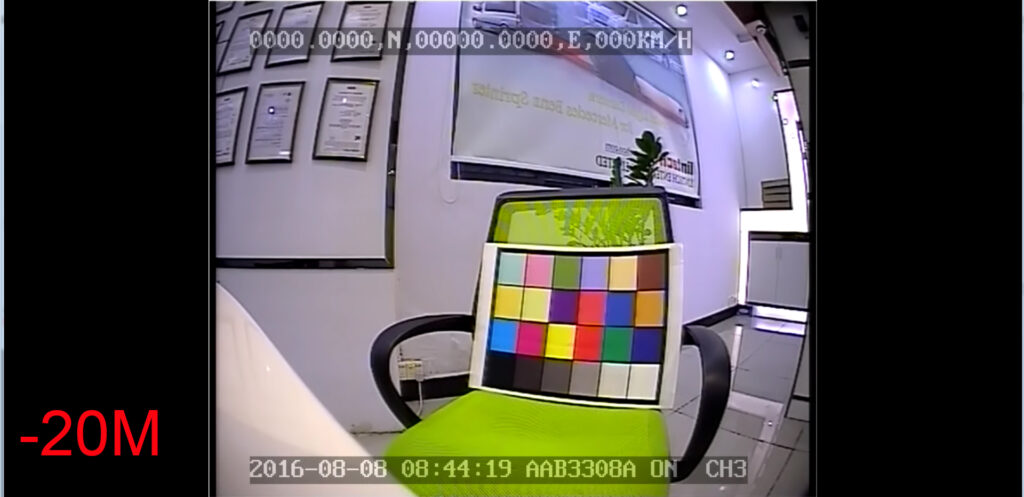
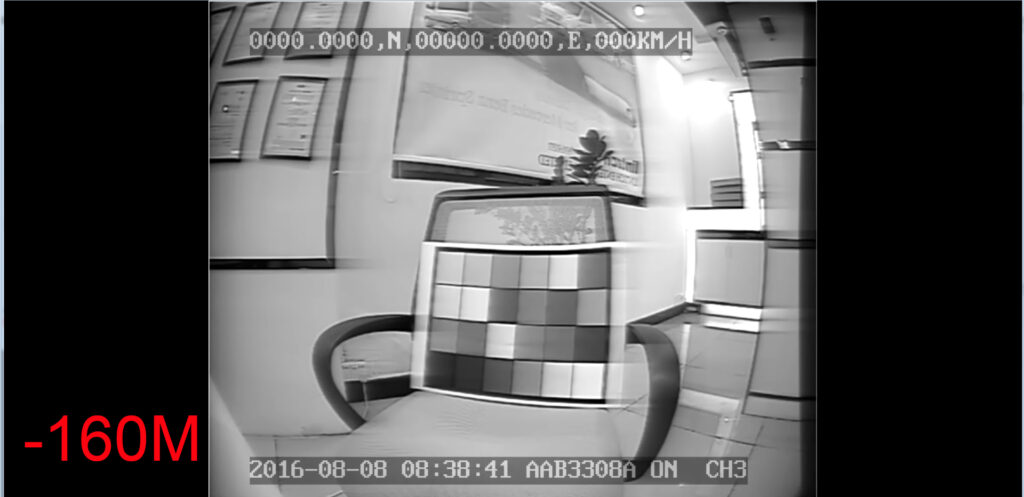
Real Case: Chile Convoy Over 150 Meters
One of our South American clients in Chile encountered a typical long-distance installation issue. The project involved a transportation convoy with a total length exceeding 150 meters. From a buyer’s point of view, it looked simple: install cameras along the convoy and send the video back to the driver or monitoring unit. But from a signal transmission point of view, this is far beyond a normal AHD vehicle camera cable distance.
In this type of application, using standard AHD extension cables one after another is risky. The total cable length may create serious signal attenuation. The video may become black and white, unstable, delayed, or completely lost. Even if the image works during a short test in the workshop, it may fail after installation because the vehicle environment adds vibration, electrical noise, connector movement, and power fluctuation.
This case is a good reminder: when the cable distance is over 80 meters, especially when it reaches 100 to 150 meters or more, the project should not be designed like a normal rear view camera system. It needs a special technical plan, such as signal repeaters, local DVR recording, IP camera transmission, wireless bridge solution, or placing the recording/control unit closer to the cameras.
Why Cable Quality Is More Important Than Many Buyers Think
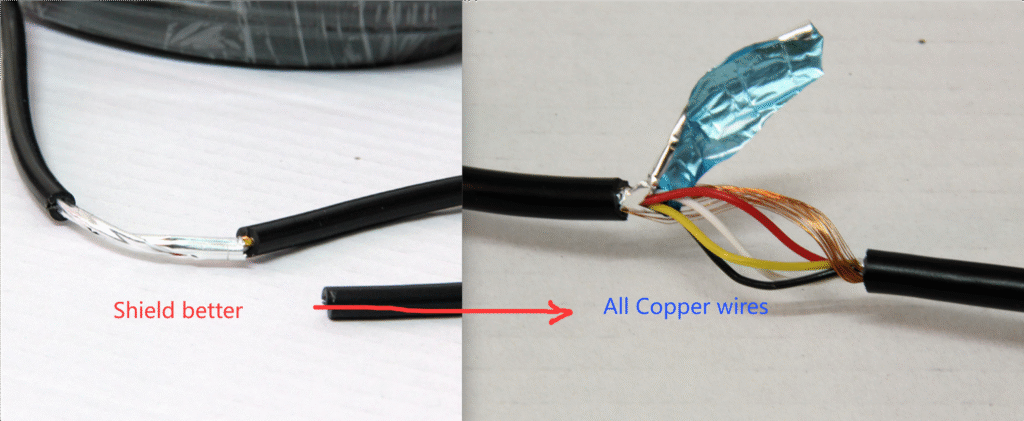
Two cables may look similar from the outside but perform very differently. AHD video depends heavily on conductor quality, shielding, impedance consistency, connector quality, and waterproof protection. Cheap extension cables may work on a 10 meter installation, but they may fail at 30 or 40 meters. This is why simply asking for the lowest cable price can create hidden installation costs later.
For truck and trailer CCTV systems, the cable must also survive vibration, water, dust, oil, temperature change, and repeated movement. In tractor-trailer systems, the spiral cable and connectors are especially important because they are exposed to pulling, bending, and outdoor conditions. A weak connector can create signal loss even if the cable itself is not very long.
Installers should avoid unnecessary cable joints. Every extra connector is a possible weak point. If the project needs 30 meters, it is usually better to use one suitable 30 meter cable instead of connecting three 10 meter cables together. For long trailer applications, waterproof aviation connectors, proper locking structure, and correct cable routing are all important.
Recommended Cable Length Design for Truck and Trailer Systems
For buyers and fleet managers, the safest method is to calculate the real cable path before ordering. Do not only measure the vehicle length. The cable usually does not run in a straight line. It may go from the monitor to the dashboard, down through the cab, along the chassis, through the trailer connector, along the trailer frame, and finally up to the camera position. This routing can add several extra meters.
For a single truck rear camera, 15 to 20 meters is normally enough. For a tractor and semi-trailer, 25 to 35 meters is common. For long trailers or special equipment, 40 to 50 meters may still be possible with good components. For 80 meters or longer, the design should be checked carefully before shipment. For 100 meters or more, we recommend testing with the full cable length before final installation.
For a convoy over 150 meters, standard AHD cable is not the right first choice. It is better to redesign the system architecture. For example, cameras can record locally on an MDVR installed closer to the camera group. If remote viewing is needed, video can be transmitted through 4G, WiFi bridge, or IP-based equipment depending on the working environment. This is more reliable than forcing one long analog cable to do a job it was not designed for.
Common Mistakes to Avoid
The first mistake is believing that AHD can run any distance because it uses analog-style cable. AHD is flexible, but not unlimited. The second mistake is mixing different cable quality in the same system. A good camera and monitor cannot fully solve the problem if the cable is weak. The third mistake is ignoring power supply. For long cable runs, camera voltage should be checked at the camera end, not only at the power source.
Another common mistake is testing the system with a short cable on the table and assuming it will work the same after installation. A workshop test is useful, but long vehicles need full-distance testing. For fleet projects, it is also better to test one complete vehicle before mass installation. This helps confirm image quality, cable routing, connector protection, and night vision performance.
Kysail’s Practical Recommendation
For most truck, trailer, and fleet CCTV projects, AHD remains a very practical and cost-effective solution. It gives clear HD video, easy installation, and strong compatibility with many vehicle monitors and DVRs. But cable length must be designed realistically. Within 20 to 30 meters, AHD is usually very safe. Around 50 meters, it can still work well with good cable and proper installation. Above 80 meters, the risk increases. Above 100 meters, testing and special design become necessary. For 150 meter convoy applications, a normal AHD extension cable design should be avoided.
If you are a buyer, driver, fleet manager, or CCTV installer, the key point is simple: do not design the cable length only by vehicle length. Design it by real cable route, signal quality, power drop, connector reliability, and future maintenance. A few dollars saved on cable may create many hours of troubleshooting later.
Kysail can support standard truck camera kits, tractor-trailer spiral cable systems, MDVR recording systems, and customized long-distance vehicle CCTV solutions. Before starting a large project, share the vehicle type, camera positions, monitor or DVR position, required cable route, and total estimated distance. With this information, we can help you choose a more reliable cable and system design before installation.